

Short Film Program
Introduction Prof. Dr. Evelyn Echle
Experimental films are among cinema’s earliest and most radical explorations of the city. Long before urban spaces became the natural setting for fictional narratives, filmmakers explored their dynamics through montage, rhythm, movement, and light. In these works, the city does not appear merely as a backdrop, but as a network of streets, facades, bridges, traffic, and people—as an organism whose energy unfolds only through the cinematic gaze.
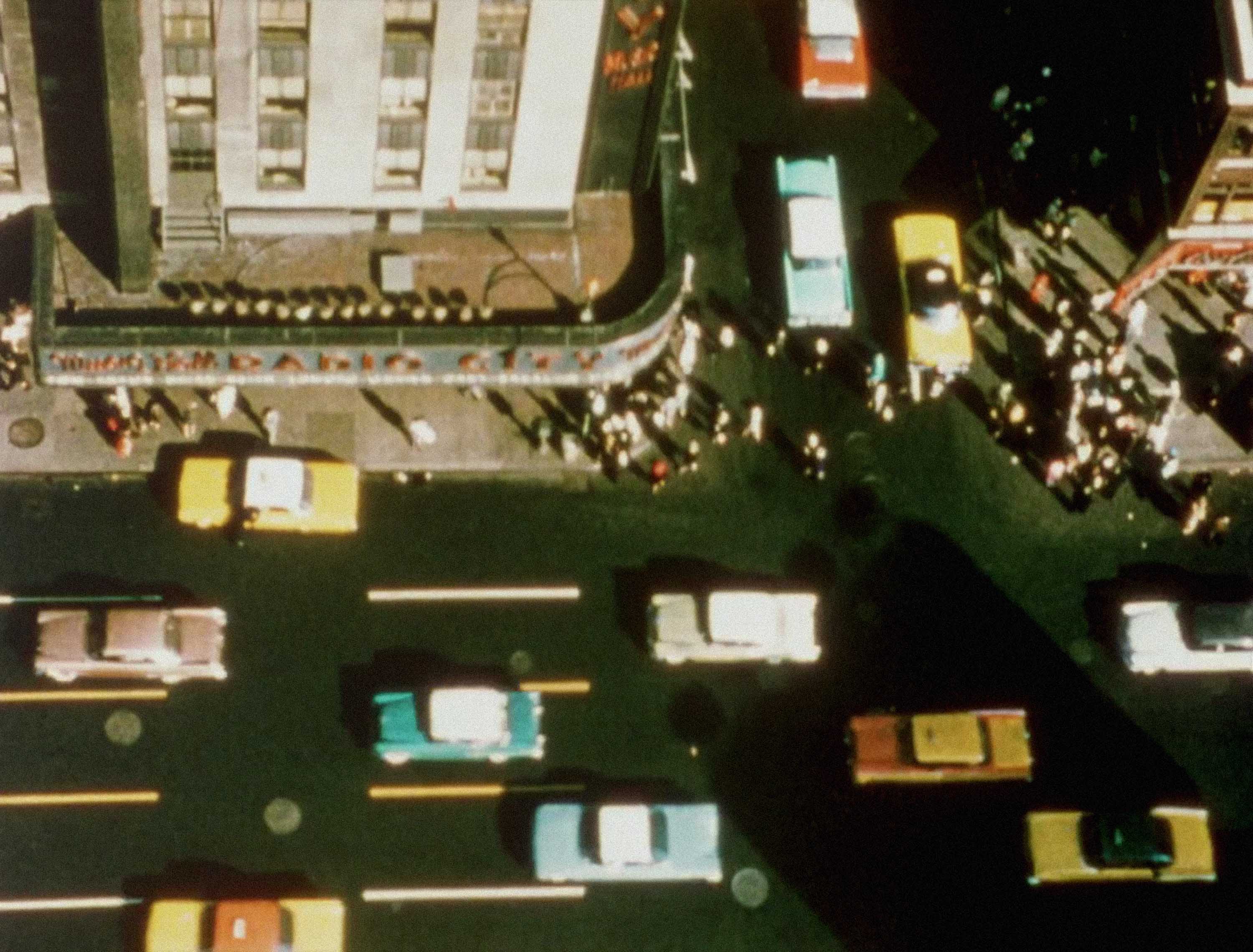
As part of our series “Cinema Above the City,” we are presenting a selection of classics and rediscovered gems from film history that explore the relationship between cinema and urban space in a wide variety of ways. From the early urban symphonies *Manhatta*, *Jeux des reflets et de la vitesse*, and *Rain*, through the pulsating visual compositions of Shirley Clarke, D. A. Pennebaker, and Marie Menken, to Claude Lelouch’s legendary *C’était un rendez-vous*, the program brings together films that not only depict the city but set it in motion.
Evelyn Echle (Dr. phil.) is a professor of cultural and media theory in the Design Department at Pforzheim University and the Bern University of the Arts. Her research focuses on the aesthetic intersections of experimental media cultures, with an emphasis on film and media history.
Films
A Tale of Two Cities
Jem Cohen interweaves footage from his hometown of New York with images from Vienna: an empty stairwell here, a bustling street there. The familiar differences in architecture and cityscape gradually dissolve; places shift in form and character. The more similar the mostly nocturnal images become, the more the two cities seem, for a moment, to share a common history. Filmed in part at the Anatomical Institute of the University of Vienna, white, motionless faces gaze back at the viewer as silent witnesses.
Rain
A rain shower over Amsterdam serves as the starting point for a play of light, water, and rhythm. Joris Ivens edits together puddles, dripping leaves, open umbrellas, and glistening cobblestones into a study of movement. The shots—often lasting only a few seconds—follow an almost musical logic of light and dark, wet and dry, still and in motion.
Go! Go! Go!
Go Go Go is a tour de force of rapid camera movement and single-frame activity. Films of boats taken at the harbor in single frames, from a moving automobile, on the streets of New York, at a body-builders convention, and at other locations.
Bridges-Go-Round
Shirley Clarke, one of the defining voices of American avant-garde and later independent cinema, transforms New York’s suspension bridges into pure form. The Manhattan Bridge, the Brooklyn Bridge, and the George Washington Bridge merge into a pulsating visual frenzy of steel, light, and water. New York was a recurring subject and setting for Clarke’s films.
The Wonder Ring
An important early film by Stan Brakhage, which Joseph Cornell commissioned as a record of New York's Third Avenue elevated train before it was torn down. Curiously lacking in people, the film focuses on the rhythms of the ride and reflections in train windows, finding a real-world version of the superimpositions Brakhage would later create in the lab.
Adolf Winkelmann, Kassel, 9.12.1967, 11.54h
In West Germany, the Young German Cinema movement emerged in the late 1960s, and the camera became a means of self-exploration. Adolf Winkelmann strapped his Bolex to his chest and maneuvered his way through Kassel’s pedestrian zone while filming himself—an early form of the selfie, rooted in the performance tradition, right in the middle of public space. The camera wobbles, the image tilts; passersby glance at the screen in confusion—some step out of the way, others simply keep walking as if nothing were happening.
Les Mains négatives
A slow drive through Paris in the early morning hours: empty boulevards, scattered figures, a taxi on quiet streets. Between urban solitude and melancholic observation, the city becomes a space for reflection. The “negative hands” from the Magdalenian caves—mysterious hand outlines in blue, black, and red—connect the fleeting traces of the present with those of a distant past.
Aimless Walk
A man crosses Prague to the outskirts of the city; on the Libeň Peninsula, he encounters his doppelgänger—his soul remains behind in the countryside, while he himself returns to the city. As the first genuinely Czech avant-garde film, the work turns away from a glorified portrayal of the city: The camera follows a detached protagonist whose subjective journey becomes a fragmentary visualization of urban landscapes.
Cooperation Partners: